
A Complete Guide to Dual Head Gobo Projectors
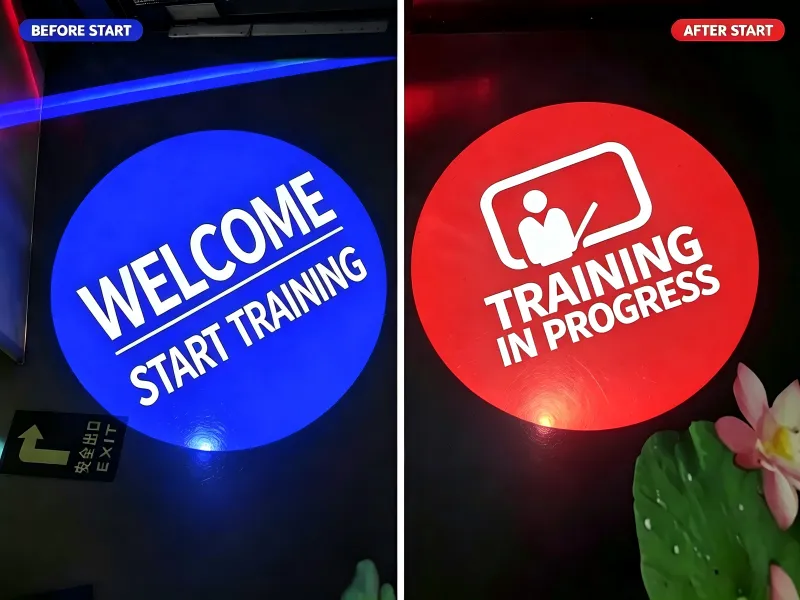
Dual projection lights, also called dual head gobo projectors, are widely used for industrial safety warnings, logo projection, commercial advertising, entrance guidance, and decorative lighting.
When purchasing a dual projection light, customers usually have two main questions:
- How does the projector switch between different images?
Does it use one lens with internal image changing, or two independent projection systems? - What does a 300W dual projection light mean?
Is it two 150W LED modules with a total power of 300W, or does each projection head have 300W?
Understanding the structure and power definition helps buyers choose the right product for their application.
1. How Does a Dual Projection Light Switch Images?
Dual Independent Optical System (Standard Design)
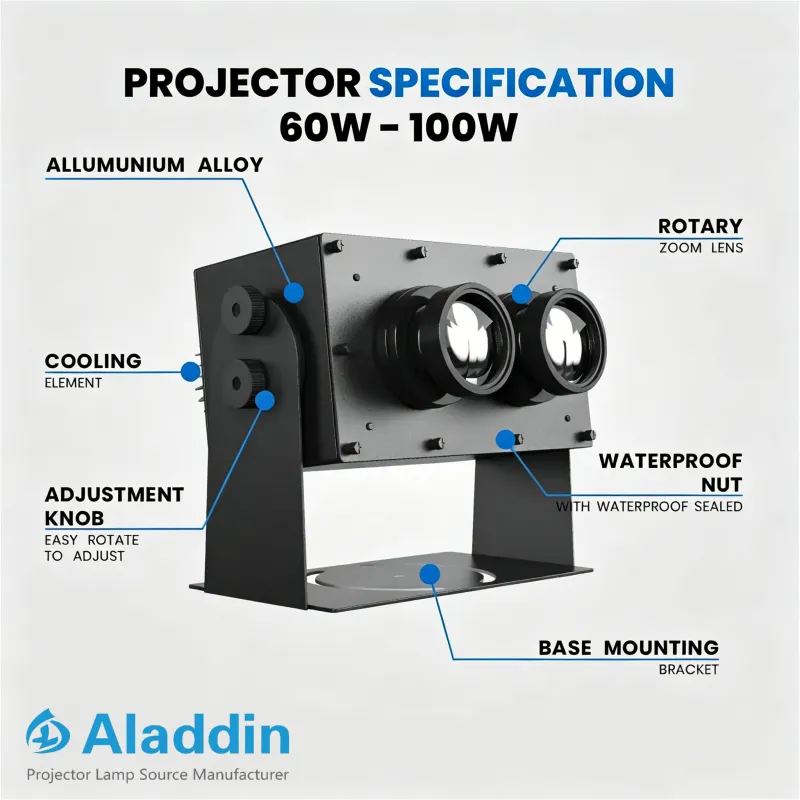
A professional dual projection light usually adopts a dual optical path design.
The product contains two independent projection modules, including:
- Two LED light sources
- Two gobo films
- Two optical lenses
- Two independent projection channels
Each lens works separately and can project different images.
Image Switching Process:
For example:
Projection Image A:
- Lens A turns on
- Image A is projected
- Lens B remains off
Switching to Image B:
- Lens A turns off
- Lens B turns on
- Image B is projected
The image change is achieved by controlling the two projection units, not by changing images inside one lens.

Can a Dual Projection Light Project Two Images at the Same Time?
Yes.
Because the two optical systems are independent, some models support:
- Two images projected simultaneously
- Different warning symbols displayed together
- Logo + safety warning combination
This function is commonly used in:
- Factory safety areas
- Forklift warning systems
- Entrance management systems
- Commercial advertising displays
2. Difference Between Dual Projection Light and Multi-Image Gobo Projector
Some customers confuse dual projection lights with rotating gobo projectors.
They are different products.
| Product Type | Structure | Image Switching Method |
| Dual Projection Light | Two independent lenses | Switch between two projection modules |
| Multi-Image Gobo Projector | One lens | Internal rotating gobo wheel |
A true dual projection light normally has two separate projection lenses.
A single-lens product with rotating images should not be considered a standard dual projection light.
3. Dual Projection Light Power Definition: What Does 300W Mean?
The power marking of dual projection lights may vary between manufacturers.
A “300W dual projection light” can have two possible meanings.
Option 1: Total Power 300W (Most Common)
Configuration:
2 × 150W LED modules
Total system power:
300W
Working mode:One projection head: 150W
Advantages:
- Balanced heat dissipation
- Lower cost
- Suitable for most outdoor waterproof applications
Common description:
300W Dual Projection Light (2×150W)
Option 2: Each Head 300W (High Power Version)
Configuration:
2 × 300W LED modules
Total system power:
600W
Working mode:
- One projection head: 300W
- Two projection heads: 600W
This type is mainly used for:
- Long-distance projection
- Large factories
- Outdoor industrial warning
- Large projection areas
Because of the higher power, it requires:
- Stronger cooling system
- Higher power supply capacity
- More installation requirements
4. What Should Buyers Confirm Before Ordering?
To avoid misunderstanding, buyers should confirm:
1. Actual Power Configuration
Confirm whether the product is:
2×150W (Total 300W)
Do not judge only from the product title.
2. Product Nameplate Specification
The final reference should be:
- Rated input power
- Product nameplate
- Technical specification sheet
This ensures the delivered product matches the required application.

Application Selection Guide
| Application | Recommended Configuration |
| Shopping mall logo projection | 2×150W dual projection light |
| Entrance guidance | 2×150W dual projection light |
| Factory forklift warning | 2×150W or higher power model |
| Large outdoor safety warning | 2×300W high power model |
| Long-distance projection | High-power dual optical system |
FAQ About Dual Projection Lights
1. What is a dual projection light?
A dual projection light is a projector with two independent optical systems. It usually includes two LED sources, two gobo films, and two lenses, allowing two different images to be projected or switched.
2. How does a dual head gobo projector change images
A dual head gobo projector changes images by controlling two independent projection heads. One lens turns off while the other lens turns on, creating image switching.
3. Does a 300W dual projection light mean each head is 300W
Not always.
A 300W dual projection light may mean:
- 2×150W modules with 300W total power
or:
- 2×300W modules with 600W total power
Always confirm the actual power configuration with the supplier.

4. What is the difference between a dual projection light and a rotating gobo projector?
A dual projection light uses two independent projection systems.
A rotating gobo projector usually uses one lens and a rotating image wheel.
Dual projection lights provide better image stability and are more suitable for industrial warning applications.
5. Can a dual projection light display two images simultaneously?
Yes. Some dual projection lights support simultaneous projection of two images, such as a company logo combined with a safety warning symbol.
6. Which dual projection light is suitable for forklift safety warning?
For forklift safety applications, a dual optical path projector with independent lenses is recommended because it provides:
- Clear warning images
- Stable operation
- Flexible image switching
- Better visibility in industrial environments
Conclusion
When choosing a dual projection light, buyers should focus on two key factors:
- Optical structure
Choose a true dual optical system with two independent projection lenses. - Power definition
Confirm whether the rated power refers to the total system power or each projection head power.
A correct understanding of the structure and power configuration helps ensure better projection performance and a reliable lighting solution.